
In the latest CIHT Guest Blog, proudly sponsored by WSP, we take a detailed look at the subject of 'Great Places, For Life'. Adrian Hames, Director & Head of Transport Planning for WSP takes a deep dive into the topic ahead of his presentation at the CIHT Young Professionals Conference taking place in December 2021.
Join other savvy professionals just like you at CIHT. We are committed to fulfilling your professional development needs throughout your career
Every city, town and village has a life, and community, of its own. We need to nourish their unique purpose, culture, and vibrancy so people are happier in their surroundings. We need to empower the activity of being alive providing people with belonging, connecting, fostering wellbeing, and striving for better. We all have a role to push for streets and places where human energy, experience, and health and wellbeing can grow strong, now and into the future. Wherever you are right now, look around and ask yourself, what is this place for? It could be it’s for working, or playing, or travelling, or shopping, or for taking it easy at the end of the day. That all sounds marvellous. But look around you and imagine, what if this place had the power to make you healthier? Even happier? Well, it does. Because where you live can be as important to your wellbeing as how you live.

Streets and roads make up around 75% of all public space. Their design, appearance, and the way they function have a massive impact on the quality of people’s lives as well as the economic and social vitality and environmental sustainability. Therefore, streets and places have a crucial role to play. We should plan places with more walkable streets and greater paths to success. Getting the approach right is therefore essential to deliver better public spaces. We need to create places for health, happiness, and life. At WSP we believe that creating more Liveable Places is an initiative whereby we can take a holistic view of our community environments to plan, design and deliver schemes which ensure our streets and places meet the needs of people. A Liveable Place can encompass an entire neighbourhood, or a small street and examples include low traffic neighbourhoods, high street transformations, school streets, corridor schemes and pedestrian priority streets.
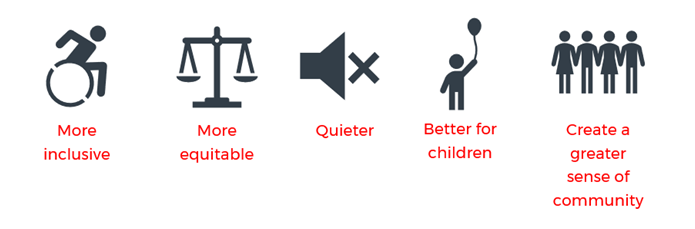
There is a focus on and increased public awareness off sustainability, physical health, mental wellbeing, and social cohesion. The need to prioritise people and place rather than accommodating the demand for motor vehicles is being increasingly recognised. The holistic approach to planning and design which needs to be taken to achieve this is also becoming more widely adopted. Liveable Places applies this approach together with good practice to create environments which deliver:
Our WSP research found that “72% of people we surveyed said they were more likely to support infrastructure developments in their local area if the projects were obliged to improve the local natural environment”. Our research also showed that people place access to nature second only to crime in their priorities for what makes a good neighbourhood: 66% of people thought it was vital. What’s clear, though, is that people want to see improvement in their local area. A year of Covid lockdowns and restrictions has focussed people’s attention and activity on their local area, from where they shop to how they access nature. By integrating Liveable Places principles into our thinking from the outset and working collaboratively to balance it with other outcomes, we can ensure that the gains from streets projects add up across biodiversity, economic, social, and environmental factors to create a positive future. Healthier, cleaner, greener, more attractive, safer, and future ready.
We are applying these principles of people in our development of the update to the DfT and CIHT design guidance Manual for Streets.
We all to need to work with the community and local organisations to effectively engage and co-create street designs to achieve positive outcomes that benefit everyone. Communities can provide valuable input that helps you to come up with a scheme that the community owns, one that not only benefits Liveable Places but also benefits people through factors such as providing access to green spaces and active travel routes.
Adrian Hames is a Director and Head of Transport Planning in the UK currently leading the development of the update to Manual for Streets.
They will be continuing the conversation at the upcoming CIHT Young Professionals Conference 2021.



Join other savvy professionals just like you at CIHT. We are committed to fulfilling your professional development needs throughout your career
{{item.AuthorName}} {{item.AuthorName}} says on {{item.DateFormattedString}}: