
COP 26 is over. The diplomats, delegates and activists have all gone home, the stages have been packed away and the media have moved on to the next story. So what can we take away from these 2 weeks in Glasgow?
Join other savvy professionals just like you at CIHT. We are committed to fulfilling your professional development needs throughout your career
The final text of the Glasgow Climate Pact, with its last minute watering down of language around coal and fossil fuel subsidies was obviously disappointing. This glacial pace of change is particulary alarming when set against analysis published during COP that concluded that the sum of the pledges made by governments in their national carbon reduction plans would result in warming of 2.4 degrees by the end of the century. This rises to 2.7 degrees if the policies actually being followed are the basis of the analysis. This is well above the 1.5 degrees rise that the scientists making up the Inter-Governmental Panel on Climate Change have advised is the threshold for preventing the most dangerous impacts of a warming planet. In short we still have a yawning gap between high level commitments and concrete action.

Andrew Crudgington, CIHT Climate Change Associate
Taking a step back from all the noise of the conference, the fundamental challenge facing transportation professionals in the UK hasn’t changed. We need to deliver very deep cuts in the emissions from surface transport and we need to do it fast. The graph below is from official government advisory body the Climate Change Committee (CCC)’s 6th Carbon Budget from 2020. As you can see, if we want to stay on course to reach Net Zero transport by 2050, emissions need to come down by around 50% by 2030. Or in other words, the battle is going to be won or lost in the next 10 years.
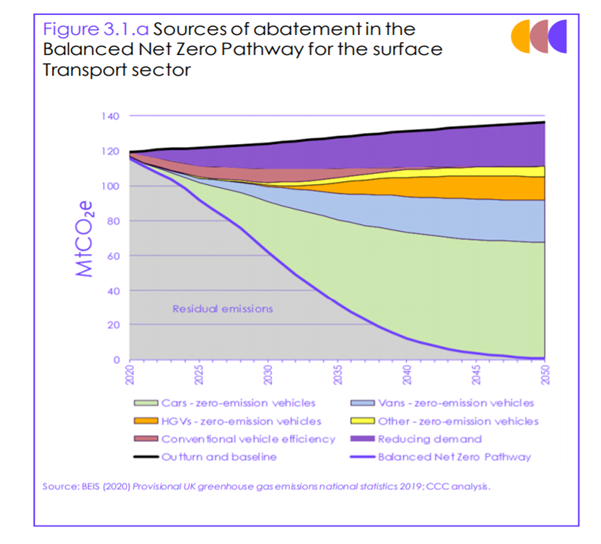
What is also clear is that throughout the 3 decades up to 2050 and particulary in the next 10 years, reducing demand for travel has to do a big part of the heavy lifting.
In truth, COP 26 wasn’t very helpful in reinforcing this truth. COP’s Transport Day on 10 November had an overwhelming focus on electric vehicles. ELVs are of course a vital part of the mix but not a complete solution. That focus – which too often is reflected in the rhetoric of Ministers – can also give the impression that an electrified status quo is possible and desirable, at a time when leaders really need to be making the case for change.
The centre piece of Transport Day was the publication of the COP26 Declaration on Accelerating the Transition to 100% Zero Emissions Cars and Vans. The declaration isn’t legally binding and doesn’t form part of any international treaty, some important countries didn’t sign up, including Germany, China and the USA and nor did some major motor manufacturers including Toyota, Volkswagen and Renault-Nissan. Ford, General Motors and Jaguar Land Rover did however join a large group of national governments in pledging to end the sale of petrol and diesel vehicles in “leading markets” by 2035 and globally by 2040. This is progress but almost certainly not enough. Speaking at a CIHT Dubai seminar on 16 November to review COP, Professor Stephen Wilkinson of University of Wollongong, Dubai reminded the audience that if we wanted a decarbonized fleet on the roads by 2050, all new vehicles need by Zero Emissions at the tailpipe by around 2030.
One bright spark was the late addition to the transport day declaration of the following text, “we recognise that alongside the shift to zero emission vehicles, a sustainable future for road transport will require wider system transformation, including support for active travel, public and shared transport, as well as addressing the full value chain impacts from vehicle production, use and disposal”. This doesn’t in itself mean a great deal but does provide a platform for pushing for further action at COP 27 next year, when thanks to the introduction of a new ratchet mechanism, countries will have to revisit their decarbonisation plans and put forward new proposals for bringing emissions down yet further.
Here in the UK there is much we can and must get on with now – and it doesn’t all demand either further central government intervention or new technology to reach maturity and scale.
I’d like to see an intense focus on that purple wedge of demand reduction in the CCC graph above. COVID-19 has unleashed a lot of creativity in the transport profession that we need to tap into fast. At that CIHT Dubai COP 26 mentioned, several speakers talked about tactical urbanism, using flexible short term projects to experiment quickly with changes to street design or services. Adopting an agile, action orientated approach – and of course rapidly scaling up what works and has public support - seems to me a good default attitude for many in our profession over the next crucial decade.


Join other savvy professionals just like you at CIHT. We are committed to fulfilling your professional development needs throughout your career
{{item.AuthorName}} {{item.AuthorName}} says on {{item.DateFormattedString}}: