
In association with Re-flow
Most organisations know where the risks sit in highways work. The harder question is how consistently those risks are being managed under tight delivery pressure – and how impactful failures can be.
The Re-flow Health and Safety in Highways Report 2026 provides a clearer view of how those risks are being recorded, applied, and controlled across the sector. It spans everything from site-level failures and reporting practices to incursions, worker abuse, and the systems used to manage them.
The report draws on recent incident data, industry discussions, and supply chain input – and sets out the latest updates in a quick-to-read format.
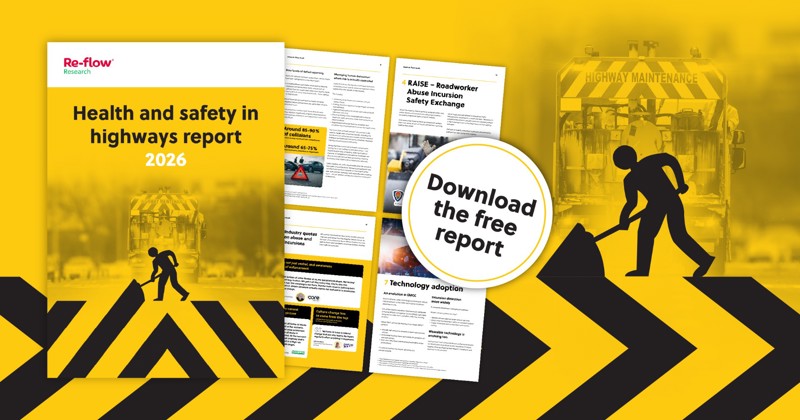
The Health and Safety in Highways Report 2026 focuses on five core areas:
These are the issues shaping how work is planned, delivered, and controlled across the sector.
They highlight how improving safety outcomes directly supports more consistent standards across projects, teams, and supply chains.
Repeated, avoidable failures continue to appear in serious incidents
Recent HSE cases show that many incidents stem from familiar issues:
This is reflected in enforcement data, with over £33 million in HSE fines issued and multiple fatalities recorded.
The report focuses on how and why these failures are still breaking down in practice.
Reporting does not capture the full picture of risk
The effectiveness of any safety process depends on what gets recorded.
Across highways, the report highlights inconsistencies in how incidents are captured and acted on:
Incursions remain a persistent and unpredictable risk
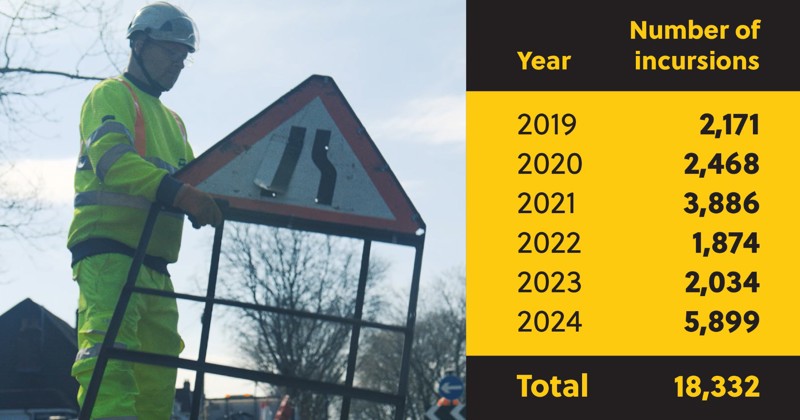
Incursions into live works continue to be recorded at scale across the network.
Worker abuse is widespread but still underreported
The report also brings together industry input on abuse faced by operatives.
Key themes include:
Across different sites, contracts, and teams, processes exist, standards are defined, and controls are in place – but they are not always applied, recorded, or followed through in the same way, particularly under pressure.
The report shows how that inconsistency plays out in practice. In construction, avoidable errors account for around 21% of project value, and 39% of injuries occur during rework – linking day-to-day delivery pressures directly to both safety outcomes and commercial impact.
The Re-flow Health and Safety in Highways Report 2026 draws on data and guidance from the Health and Safety Executive, National Highways, and the Supply Chain Safety Leadership Group.
It also incorporates official UK road safety statistics, industry webinars, enforcement case studies, emerging initiatives such as the Home Safe and Well programme, and first-hand commentary on abuse and incursions from influential figures at RAISE.
For a complete view of the data, case studies, and impacts download the Health and Safety in Highways Report 2026 now.

About Re-flow:
Re-flow Field Management helps businesses stand out against the competition by raising the standard of how work is planned, delivered, and recorded. From quoting through to delivery and beyond, it creates a more efficient, joined-up way of operating – bringing compliance, site management, billing, and reporting into a single, connected flow.
CIHT Statement
The opinions expressed in this article are those of the authors. They do not purport to reflect the opinions or views of the CIHT or its members. Neither the CIHT nor any person acting on their behalf may be held responsible for the use which may be made of the information contained therein


