
This project, implemented by Lancashire County Council (LCC) and Atkins, demonstrates a compelling contribution to sustainable working practices and carbon reduction in Local Highways. The case study describes the adopted approach in producing a ‘Highways Decarbonisation Strategy and Action Plan’ and the benefits realised. The methodology is easy to replicate for other organisations and sectors.
The approach is unique because it focusses on the existing infrastructure and the associated backlog of maintenance. Whereas currently available guidance is centred upon new design and construction or corporate estate carbon footprint.
The mission statement for the project is to achieve ‘Sustainability through Durability’.
Join other savvy professionals just like you at CIHT. We are committed to fulfilling your professional development needs throughout your career
In December 2020, the LCC Full Council adopted a resolution to set out an ambitious carbon reduction and nature recovery strategy that seeks to 'transition the Lancashire economy away from carbon by 2030 and address the biodiversity crisis'. Subsequently, In June 2021, the Government set the sixth carbon budget in line with the level advised by the Committee on Climate Change, and to achieve a 78% reduction of net emissions by 2035 (based on 1990 baseline levels).
The development of LCC’s Highways Decarbonisation Strategy reflects the Government’s 2035 carbon budget. The Full Council resolution supports their Corporate Priorities and, in particular, addresses the need to protect the environment by establishing a strategy to achieve a realistic carbon reduction from highways maintenance and related activities. This clear executive commitment to reduce carbon emissions provided the mandates to develop an Action Plan to deliver against these ambitions.
LCC’s Asset Team partnered with Atkins to determine the Highways function contribution towards the Councils overall carbon emission targets; identifying ‘hot spots’ that could be addressed in the short term and the areas requiring greater innovation that needed to be prioritise in the longer term.
The team recognised early on that the decarbonisation challenge is multi-faceted and the deployment of resolutions cannot be done in insolation. To drive progress, the team defined boundaries of activity within their direct control of influence. It became evident that a Road Map was required to co-ordinate efforts, assign accountabilities and deliver improvements.
The project is innovative because addressed the existing infrastructure and the associated backlog of maintenance. The approach comprised of a structured 12-week programme of interactive workshops with subject matter experts, asset managers and staff from the following Council services:

The draft Strategy was shared informally for comment with all the stakeholders involved along with the Environment and Climate Manager and the Cabinet Members for Highways and Transport and Environment and Climate, before being discussed and formally agreed upon by the Highways Asset Management Strategy Board. The Strategy was then presented to Cabinet on 7th April 22 and was formally adopted.
The project ran on time and to budget and deliverables were structured into the following components:
Policy areas: the ten guiding principles that reflect Lancashire’s commitment to decarbonisation. These were endorsed by the senior management team and used in cross-organisational communications to raise awareness.
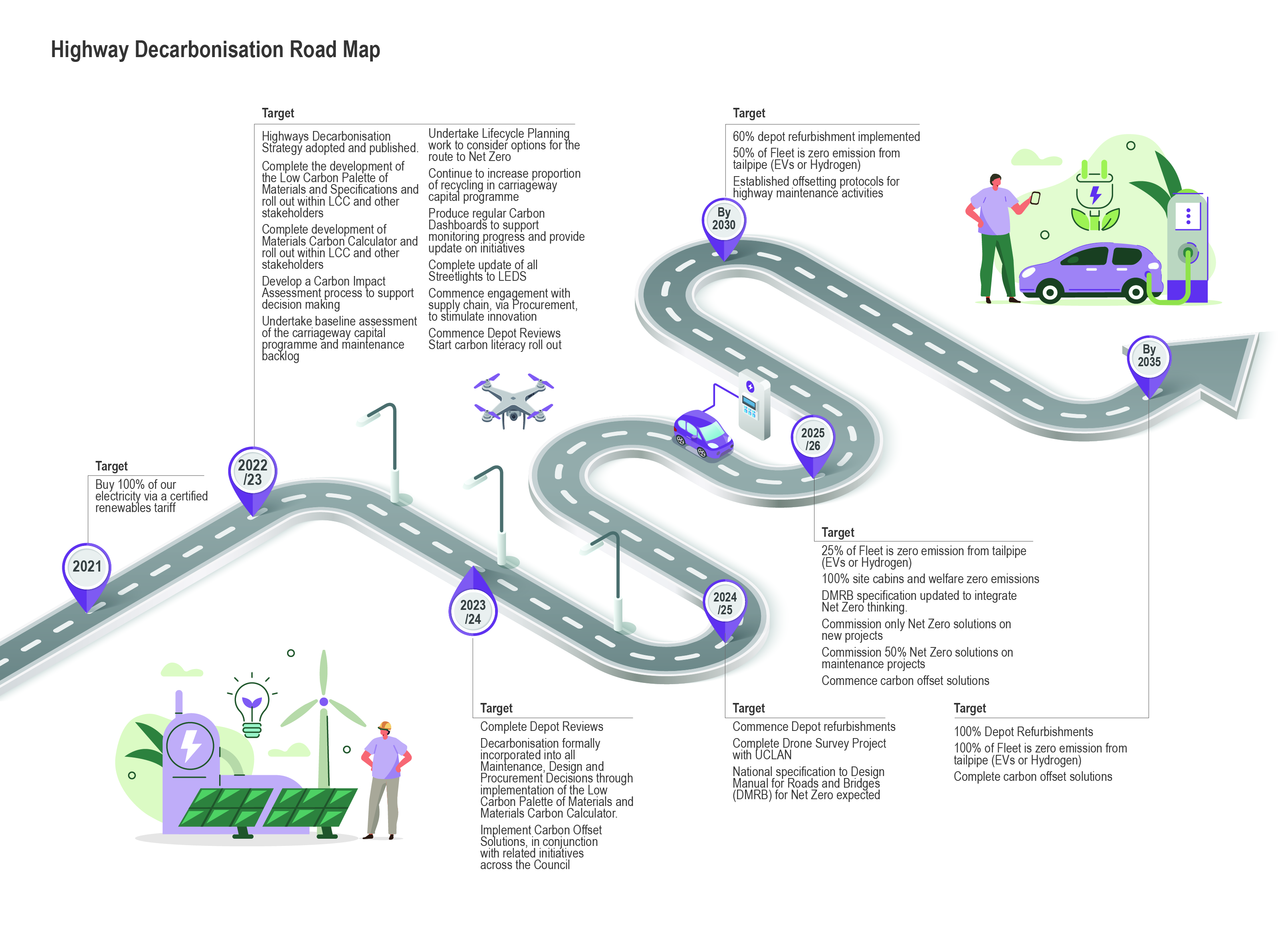
Road map: a visual representation of the journey, describing how they will go about delivering Highways’ contribution towards the Council’s carbon reduction target. Acknowledging the successes already achieved and raising awareness amongst staff, Members and the supply chain.
Carbon action plan: setting out the specific detailed initiatives that the various teams will be pursuing up to 2035. There is clear governance of the plan, with a dedicated steering group, and aligned to the initiatives going on in the wider Council and Greater Lancashire Region. Prior to commencement, each initiative has to be fully resourced, funded and have clearly defined benefits with an accountable owner.
In terms of implementation, the Carbon Action Plan sets out specific targets for 2022/23 and future years. Progress is monitored through existing governance structures with progress reports reviewed by the Highways Asset Management Strategy Board. Outcomes are regularly reported to Cabinet and are available publicly through the Transport Asset Management Refresh process.
The Highways Decarbonisation Strategy is rapidly gathering interest from across the sector and it has been showcased at industry seminars including: FHRG, LCRIG, MHA, APSE and CIPFA. There have also been several articles published in local, regional and international media.
The multi-skilled team worked collaboratively throughout, taking the time to learn and research the ‘new language’ and legislation associated with decarbonisation and what it means to their area of the business.
Fundamental to success was the engagement of stakeholders from the outset, and the passion and contribution demonstrated from people involved. The project successfully raised awareness of climate emergency issues to a broad range of stakeholders at all levels of the organisation and supply chain. This generated the necessary sense of urgency for staff to take ownership of the issues that they can readily influence.
The Strategy has set the foundations for achieving Highways’ contribution toward the Council’s Net Zero target. It has facilitated the essential cultural change, such that everyone now takes responsibility for their contribution to decarbonisation.
Benefits already realised include:
Street Lighting Energy (purchase of green energy): 5000 CO2eT saved, 100%
Carriageway Renewal Programme (recycled materials): 709 CO2eT saved, 19%
The Strategy has stimulated innovation and collaboration in the pursuit of circular economy solutions. The Asset Team is now engaged with the supply chain and academia to develop lower carbon solutions. For example, the use of biogenic binders, reclaimed asphalt and warm mix additives can realistically start getting closer to a true carbon neutral treatment for road resurfacing schemes. This will be particularly applicable on unclassified roads and enable LCCs objective to tackle the maintenance backlog.
As the Department for Transport places greater emphasis on business cases that promote carbon reduction, the Strategy will help attract additional funding. It is also anticipated that DfT self-assessment questionnaire for incentive funding will be expanded to include scoring for decarbonisation. The Action Plan will embed procedures to collect evidence in respect of these new areas so LCC can achieve Band 3 status and secure additional funding.
The Asset Team are making more informed decisions around most appropriate treatments to reduce carbon across the whole asset life cycle. Procurement guidance and contract evaluation criteria are being refreshed to ensure that measures are in place to incentivise the supply chain transparently and fairly on Scope GHG 3 emissions.
In summary, the Highways Decarbonisation Strategy and Action Plan has been embraced across the Council. The approach is easily repeatable and LCC has a commitment to share best practice and engage with other Local Authorities and industry partners. As LCC progress on their decarbonisation journey, they will ensure successes are shared and celebrated.


Join other savvy professionals just like you at CIHT. We are committed to fulfilling your professional development needs throughout your career