
Government is urged to develop a national bus strategy to help place bus travel at the heart of future infrastructure planning.
Join other savvy professionals just like you at CIHT. We are committed to fulfilling your professional development needs throughout your career
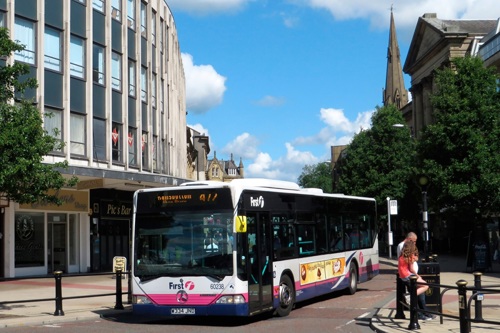
The Confederation of Passenger Transport UK also calls for local transport authorities to receive incentives to speed up bus journey times, and for Government to provide stable funding and support the cost of buying zero and ultra low emission vehicles. Trials of new mobility solutions in rural areas are also encouraged.
In return the bus sector promises to expand discounted ticketing for apprentices and job seekers, develop new rural bus plans and introduce contactless, multi operator, price capped ticketing in urban areas within three years.
“I joined the bus industry four months ago and one of principle reasons I did was a sense that this industry was under playing its hand,” said CPT UK’s chief executive Graham Vidler on Monday at the launch of its new buses vision ‘Moving Forward Together’. “And perhaps we as a society are not making the most of the potential of the bus.”
Every day 2.1 million people in the UK catch a bus to travel to work and there are one million journeys by bus to schools and colleges. It is also thought that 1.4 million shopping trips and 1.3 million leisure trips are made by bus every day. By 2030 the sector hopes to increase the number of journeys made by bus by one billion.
“We can do more,” Graham added. “Bus services are under performing in too many areas of the country and bus policy lacks direction. We need a national strategy to drive prosperity in towns and cities, build stronger communities, improve mobility and air quality and reduce emissions.”
Buses are at the heart of mass mobility in urban areas, he added, but are under threat from increasing journey times. In broad terms, he said, bus journey speeds have been reducing by 10% a decade for several decades. “As buses slow down, journey times become less reliable and less people use them. A decline in service means more people use cars.”
Graham added that in rural areas: “the traditional model of a big bus turning up in a village once a day doesn’t work for authorities, operators and most of all rural residents. So we need to think differently and test new solutions such as demand responsive technology which can be an important part of the solution in many areas.”
Buses Minister Baroness Vere told the event that buses “are an absolutely key part of our transport system” and promised more trials of on-demand and ultra low emission buses. Improving bus services in rural areas is a huge challenge, she added, and while there is “no silver bullet” she said that demand responsive transport can be a useful tool. But she added that some older buses cause noise problems in urban areas; something that needs to be addressed.
Transport Focus chief executive Anthony Smith said negative perceptions of buses are “generally held by people who don’t use buses”. He added: “One of the challenges is making the voices of bus users heard”.
He welcomed efforts to make buses more environmentally friendly, but pointed out: “buses can be as green as you like but if they are late, expensive and the drivers are grumpy, people will not use them.”
Last week, Chancellor of the Exchequer Sajid Javid’s Spending Round announcement included a £200M pledge of increased funding to transform bus services, ‘making best use of technology and promoting decarbonisation’.
(Photograph: simon835 and licenced for reuse under this Creative Commons Licence)


Join other savvy professionals just like you at CIHT. We are committed to fulfilling your professional development needs throughout your career
{{item.AuthorName}} {{item.AuthorName}} says on {{item.DateFormattedString}}: