
CIHT Qatar Group organized a technical seminar for Highways and Transportation professionals on “Is Road Safety in Qatar Getting Better or Worse?” held on October 15, 2019 at City Centre Rotana Hotel, Qatar.
Join other savvy professionals just like you at CIHT. We are committed to fulfilling your professional development needs throughout your career
Dr. Rafael Consunji, the Director of the Hamad Injury Prevention Program and consultant of Trauma and Critical Care Surgery at the Hamad Trauma Center, was the guest speaker where he provided an interactive session for the highways and transportation professionals.
Dr. Consunji gave an introduction by outlining the facilities available at Hamad General Hospital Trauma Center. The rescue teams of Hamad Hospital could reach any spot of the city within around 12 -18 minutes. Helicopters are also ready to rescue from remote areas. The newly opened Trauma Tower has world-class facilities and is staffed by a dedicated team of trauma doctors and nurses available 24/7.
In Qatar, road traffic injuries are a major cause of death (>10-14% of all deaths, the second highest in the world) and around 51% of all injury admissions to the Hamad Trauma Center, about 1,000 per year. The very diverse, young and highly mobile population, unrestrained passengers and distracted driving have been cited as the main risk factors for these major crashes and injuries. Children between 0 to 19 years old are most vulnerable, with 86% of their road traffic deaths occurring in the pre-hospital setting (HMC & QSA, 2010-2011); mainly due to not wearing seat belts or not being in car seats. Information from national statistics and the Qatar Trauma Registry indicated that young male drivers have the highest road traffic injury rate from motor vehicle crashes, and expatriate laborers, from right-hand driving countries, are most vulnerable as pedestrians.
The UN Decade of Action for Road Safety [DoARS], which aims for a 50% reduction in road deaths by 2020, utilizes the internationally recognized five-pillar matrix of the Safe System approach that includes: road safety management, safer roads, safer vehicles, safer road users and post-crash response. Based on an analysis of local data, Qatar achieves four out of the five pillars, except for safer vehicles, to a satisfactory level. Presently, many vehicles are still being driven in Qatar though not satisfying some United Nation’s motor vehicle safety regulations and without the application of the recommended New Car Assessment Program [NCAP]. Implementing these recommendations for safer vehicles will go a great way to ensuring that Qatar meets the objectives of DoARS by 2020.
Dr. Consunji closed the presentation session by sharing their findings that a 43% reduction in road death rates was recorded between the year 2011 and 2016 in Qatar, despite the 56% increase in the population. Statistically it is shown that road safety is better in Qatar.
The presentation was well received by the audience, followed by a detailed question and answer session. This seminar is part of CIHT Qatar Group’s events. The Group thanks their sponsors AECOM, BG&E, DCE, EGIS, FUGRO, MUHEL, PAF, PTV Group, SALFO, SEERO and WSP for their generous contribution to the event.
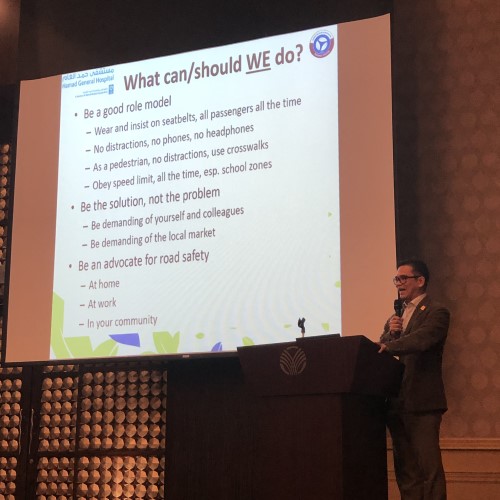
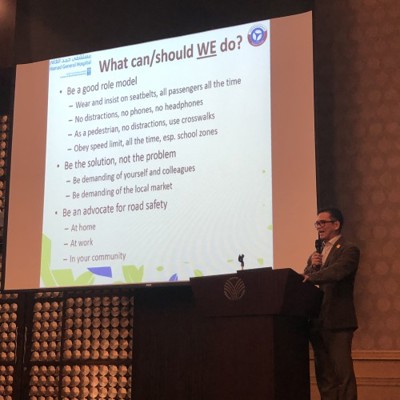
Dr. Rafael Consunji, Director of the Hamad Injury Prevention Program
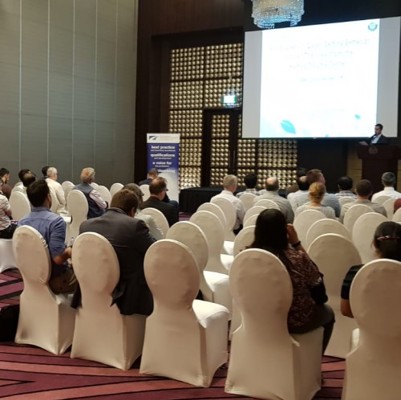
Technical Seminar on “Is Road Safety in Qatar Getting Better or Worse?” on October 15, 2019.


Join other savvy professionals just like you at CIHT. We are committed to fulfilling your professional development needs throughout your career
{{item.AuthorName}} {{item.AuthorName}} says on {{item.DateFormattedString}}: