
Levels of air pollutants and warming gases over some cities and regions are showing significant drops as coronavirus impacts work and travel.
Join other savvy professionals just like you at CIHT. We are committed to fulfilling your professional development needs throughout your career
Since the outbreak of COVID-19, NASA and the European Space Agency (ESA) pollution monitoring satellites have detected significant decreases in Nitrogen Dioxide (NO2) over China.
By January 23, 2020, Chinese authorities had shut down public transport and local businesses in Wuhan in order to reduce the spread of the disease. It was the first of several quarantines set up in the country and around the world.
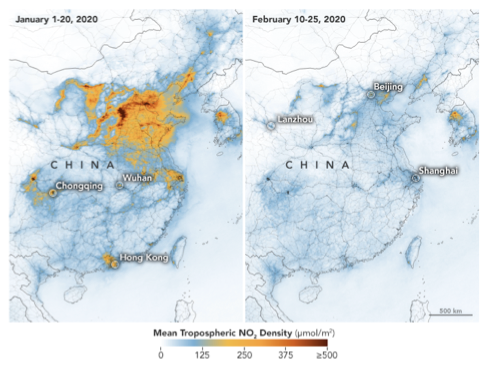
Source: NASA Earth Observatory
The maps above show NO2 values across China from January 1-20, 2020 (before the quarantine) and February 10-25 (during the quarantine). NO2 is one of a group of gases called nitrogen oxides (NOx). While all of these gases are harmful to human health and the environment, NO2 is of greater concern. Similar patterns can be observed across the world where ‘lockdown’ measures have been put in place.
Action on COVID-19 has lowered CO₂ emissions drastically, with flights suspended and factories closed in many parts of the world. This shows that if greenhouse emissions continue to rise and immediate action is required to cut them, polices are likely to be very restrictive. This highlights the importance of investment in green energy, environmentally-friendly innovation and incremental reduction in emissions.
With global economic activity slowing down as a result of the coronavirus pandemic, it is expected that emissions of a variety of gases related to energy and transport would be reduced.
The urgent question now is how to maintain the environmental benefits once the COVID-19 epidemic wanes, and how to learn from one crisis response in the pursuit of another.
As the world recovers from the COVID-19 pandemic, governments will decide measures to re-stimulate their economies. However, this could cause CO2 emissions to sharply rise. After 2008 the global financial crash, carbon emissions shot up by 5% as a result of stimulus spending that boosted fossil fuel use.
In the coming months, governments will have a chance to alter that outcome. They could insist, for instance, that any bailout of airlines would be tied to far more stringent reductions in aviation emissions.
However, if the pandemic continues for an extended period of time, any stimulus is likely to focus on achieving economic growth regardless of the impact on the environment. With decisions makers around the world focused on the COVID-19 pandemic, it is very likely that climate action is now a lower priority.
Professor Glen Peters, the Centre for International Climate Research, said:
"I certainly think the climate could go on the back burner, and in this case, I don't think there is much hope that stimulus goes to clean energy. Any stimulus will help those with job losses such as tourism and services. I think this is very different from the global financial crisis. The only silver linings could be to learning new practices to work remotely, and buying a few years of lower growth allowing solar and wind to catch up a bit, though, these may be rather small silver linings."
Companies have been forced to invest in and embrace remote working by the pandemic which could result in a permanent shift in working patterns and a decline in business travel. Increased use and acceptance of virtual connectivity could open up opportunities for more flexibility working in the future. This could create a new ‘normal’ where individuals travel less resulting in a permanent decrease in emissions.


Join other savvy professionals just like you at CIHT. We are committed to fulfilling your professional development needs throughout your career
{{item.AuthorName}} {{item.AuthorName}} says on {{item.DateFormattedString}}: