
Greenhouse gas emissions from road transport have increased by 6% over the last 30 years despite improvements in fuel efficiency and measures to encourage more sustainable travel, figures from the Office for National Statistics show.
Join other savvy professionals just like you at CIHT. We are committed to fulfilling your professional development needs throughout your career
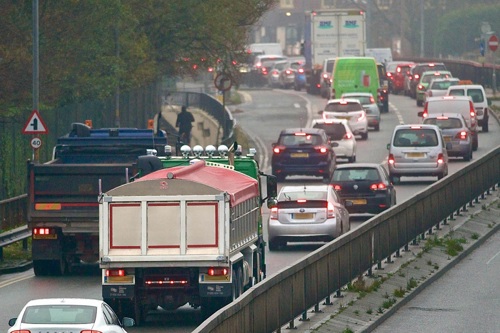
This compares to a 32% fall in the UK’s total greenhouse gas emissions since 1990. Around a fifth of these total emissions came from road transport in 2017, the figures add, with an increase in traffic of 29% since 1990 blamed for the 6% increase.
The statistics also show that, at the end of 2018, just half a percent of all vehicles licenced in the UK were ultra low emission models.
However they add that emissions of pollutants that are particularly damaging to health – such as carbon monoxide, particulate matter and nitrogen oxides – have reduced following increasingly stringent exhaust emission limits.
“The only way to stop transport from leading us to further climate breakdown is to drastically cut the miles travelled by car,” commented Friends of the Earth campaigner Jenny Bates.
“Despite noise made by vehicle manufacturers about cleaner petrol and diesel technology, transport is still the most climate polluting sector and it’s clear petrol and diesel sales have to stop as soon as possible.”
Government committed to reaching net zero carbon emissions by 2050 this summer, and has a target to end new sales of petrol and diesel vehicles by 2040.
Last week, it announced the launch of a £400M Charging Infrastructure Investment Fund to help with the rollout of public charging points for electric vehicles. The first £70M from the fund will go towards 3000 new charge points, more than doubling the number across the UK.
Release of the latest ONS figures came after CIHT launched a series of commitments in response to the climate change challenge last week.
The Institution’s Pledge to Change will see it use its position to promote the need for planning and investment to mitigate for the consequences of climate change, in relation to highways and transportation.
“The time for action is now if we are to shape tomorrow today,” said CIHT’s chief executive Sue Percy. “As the UK’s leading professional body for highways and transportation, CIHT’s Board of Trustees is calling on its members to be at the forefront of ensuring our industry responds to the need for action.”
The Liberal Democrats conference in Bournemouth also saw party members back a motion to cut carbon emissions by 75% in the next 10 years over the weekend. The party said that the Government needs to move much faster and be more ambitious in tackling the issue.
Today, Oxfordshire County and Oxford City councils announced plans to improve air quality and tackle congestion by restricting car traffic and installing bus priority measures on certain routes. The councils are also exploring the potential for a workplace parking levy in an area to the east of the city to encourage more sustainable travel.
(Photograph: DfT)


Join other savvy professionals just like you at CIHT. We are committed to fulfilling your professional development needs throughout your career
{{item.AuthorName}} {{item.AuthorName}} says on {{item.DateFormattedString}}: