
Fears that driverless vehicles may stop too often because of seagulls, leaves or plastic bags getting in their way have been expressed in a consultation paper published by the Law Commission.
Join other savvy professionals just like you at CIHT. We are committed to fulfilling your professional development needs throughout your career
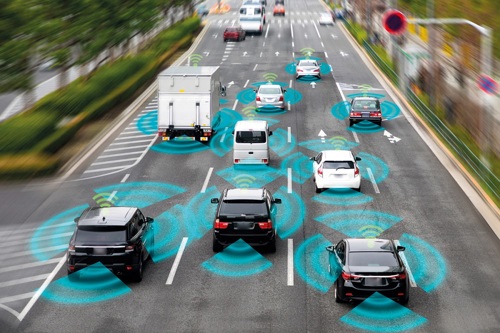
The document – which considers the regulation of self driving vehicles – warns that ‘frozen robot syndrome’ where a vehicle freezes in the presence of possible obstacles “could have a disruptive effect on traffic flow” during early stages of testing.
Another concern is that too many automated vehicles may spend their time driving around empty or driving long distances to find parking spaces.
The ability for an automated vehicle to drive empty is useful when they have to relocate, the paper states. “But there is a danger that vehicles will also ‘cruise’ – that is, they will circle around empty for no purpose”, especially if the cost of driving is less than the cost of parking.
It is also said that driverless vehicles could undermine mass transit. Once people get into a single occupancy vehicle they may decide to take it to their final destination, rather than waiting on a railway platform or at a bus stop, “particularly in the cold or wet or if they have to carry heavy baggage up and down stairs”.
In urban areas, the introduction of large numbers of new vehicles before private car use has reduced could add to congestion and pollution, it warns. Customers could also be deterred from using an automated service if they place a booking, only to find that no vehicle is available or that they face a long wait.
Rural roads could pose a problem for automated vehicles too, with technological challenges including “fewer road markings; the negotiations required to back up on single lane roads; and dealing with livestock on the road”.
The Commission’s consultation also sets out the potential benefits from automated vehicles including a reduced dependency on car ownership, less congestion and car parking and benefits for safety, the environment and people with disabilities.
A further benefit identified by the document is around the prospect of automated vehicles helping people to reclaim time. It is thought that the average driver spends the equivalent of six working weeks behind the wheel each year. “Freedom from driving could be especially valuable for those that do not enjoy driving”, the paper sates, “or in circumstances where driving is most stressful, such as stop and start traffic jams”.
Law Commission of England and Wales commissioner Nicholas Paines QC said: “Self driving cars have the potential to revolutionise mass transit by enhancing safety, efficiency and accessibility.
“Responses to our consultation are vital for ensuring that our proposed regulatory framework will allow the full potential of self driving cars to be realised, and we hope as many people as possible will respond.”
To read the consultation paper, click here. Comments are invited to automatedvehicles@lawcommission.gov.uk by 16 January.
(Image: Metamorworks – Shutterstock)


Join other savvy professionals just like you at CIHT. We are committed to fulfilling your professional development needs throughout your career
{{item.AuthorName}} {{item.AuthorName}} says on {{item.DateFormattedString}}: