
CIHT's review Improving Local Highways was part of the focus at a Public Policy Exchange event held today (23 March 2021)
Join other savvy professionals just like you at CIHT. We are committed to fulfilling your professional development needs throughout your career
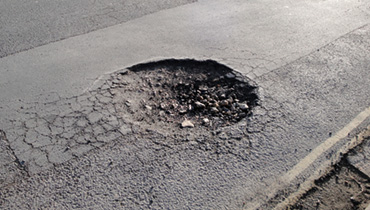
The Public Policy Exchange today (23 March 2021) held an event 'Preventing Potholes and Improving Road Infrastructure: Developing a Sustainable Strategy to Maintain UK Roads' where CIHT's review Improving Local Highways was featured.
Clive Bairsto, Chief Executive of Street Works UK Chaired the event with the opening presentation featuring Kerry McCarthy MP, Shadow Minister for Green Transport. Following the presentation by the Shadow Minister for Green Transport, CIHT's Head of Policy & Technical, Justin Ward presented. Mr Ward said:
It was great that CIHT could share the work of their review making the case for increased funding for local highways. At the same time, as part of CIHT's Climate Change Pledge it was important to stress that the future strategy for UK roads must support the move to net zero – for both how we use roads and how we maintain roads.
As 45% of carbon produced in highways sector is in the materials used we’ve got to figure out ways of addressing this carbon impact.
Last year Governments across the UK harnessed this opportunity whilst addressing reduced use of public transport and invested in supporting people to get around by cycling. There were roll-outs of low traffic neighbourhoods. Walking and cycling, arrived firmly, and sometimes controversially, on the agenda.
CIHT has long put walking and cycling at the top of the transport hierarchy and to support this our infrastructure needs to be of a high quality. Hitting a pothole on a bike can be fatal. So, more walking and cycling, implies a need for roads that are safe and in a good state of repair.
Getting a strategy that shifts pothole maintenance away from patching and towards prevention is essential.
Also speaking at the event was Mark Stevens, Assistant Director Direct Services at Haringey Council and CIHT member. Mark Stevens helped support the CIHT review Improving Local Highways and was the winner of CIHT's Transportation Professional of the Year in 2020.
The AA estimates that potholes cost drivers and insurers at least £1 million every month. Moreover, the Asphalt Industry Alliance (AIA) says that £9.7 billion is needed over the next 10 years to fix the current state of the roads. Not only is there a backlog of pothole repairs needed but the number of potholes being fixed each year has dropped from 1.9 million to 1.5 million according to the AIA, all the while the average council’s budget for highway maintenance has reduced by 16%. It has been estimated that this reduction in pothole maintenance cost road users in England over £2 billion in 2017.
The most recent action by the Government was the announcement in the 2020 Spending Review of a £2.5 billion Pothole Fund over the next five years to help local authorities fill-in around 50 million potholes across the country and stop potholes forming in the first place. This financial year alone will see £500 million from the fund go to repair 11 million potholes. As well as the extra funding which has been allocated for pothole repairs; the Department for Transport published a consultation in 2019 on the effects of utility companies’ reinstatements in the openings of roads for maintenance works and it proposed increasing the minimum guarantee for these reinstatements from two to five years and increasing the asphalt standard so as to keep roads pothole-free for longer.
Although the Government is attempting to tackle the pothole problem, many believe their strategies are not effectively confronting the problem. For example, David Renard, the Local Government Association’s (LGA) transport spokesman, said that “our roads are deteriorating at a faster rate than can be repaired by councils”. To this end, the LGA is calling for Local Authorities to be given devolved infrastructure and public transport budgets to properly address the potholes which blight the road network. Furthermore, the £2.5 billion allocated by the government last year, has been branded by the president of the AA as not enough to “do the job”. The RAC Foundation has also raised concerns about the lack of funding, however they also recognised that with an emerging economic crisis and tighter local authority budgets, a simple fiscal response may not be possible. Instead more ingenious solutions may be needed, whilst the post-Covid economic recovery may provide the optimum moment to focus on improving local roads.
This symposium, therefore, offered the chance for delegates from local authorities, highway maintenance groups, campaigners, the private sector and many other key stakeholders to come together to discuss an effective way to tackle the issue of potholes.
For more information on the event see here: Preventing Potholes and Improving Road Infrastructure: Developing a Sustainable Strategy to Maintain UK Roads | Public Policy Exchange
For further information on CIHT's Improving Local Highways see here: https://www.ciht.org.uk/knowledge-resource-centre/resources/improving-local-highways/


Join other savvy professionals just like you at CIHT. We are committed to fulfilling your professional development needs throughout your career
{{item.AuthorName}} {{item.AuthorName}} says on {{item.DateFormattedString}}: