
The CIHT Transport Sector Resilience in a Changing World took place the 11 April in London. Chaired by James Elliott, chair of the CIHT Asset Management Panel, the event explored how resilience is approached in different sectors as well as on a local, national and international level. The event was sponsored by WSP.
Join other savvy professionals just like you at CIHT. We are committed to fulfilling your professional development needs throughout your career
The full day event explored how different sectors are making their infrastructure resilient. The morning session, titled Road Resilience Readiness, saw both public and private sector representatives explain their approaches. Steve Berry, Department for Transport, started the session and one of his points, that resilience needs to be part of everyday business as usual, was echoed in the presentations throughout the day. To do this, funding is necessary, and the Department for Transport will make the case to Treasury for a Flood Resilience Fund in the upcoming spending review.
Following on from Steve Berry's presentation, the private sector, represented by WSP and Tarmac, explained how they are dealing with resilience. Chris Gibney, WSP, presented WSP's Future Ready toolkit, which is used as a systemised approach to bring resilience in to the projects that WSP are working on. For Tarmac, represented by Mark Ellerington, data is king, and it is vital to ensure best practice in asset management as well as to make the case for the importance of investment in the road network. Ending the morning session presentations was Chris Allen-Smith, Hertfordshire County Council, who explained how they have been reviewing their asset hierarchy in terms of what is most important when considering resilience and possible failure of assets. This will inform their approach to asset management.
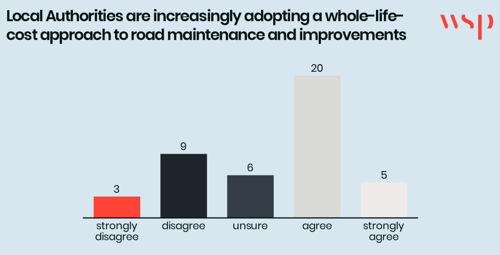
Before lunch break the speakers and delegates participated in a Q&A and a voting session where the delegates thoughts on various issues were sought. What the voting session highlighted was both negative and positive; the majority did not feel that the UK road network is ready for the future, but on the other hand the majority had confidence that local authorities are increasingly adopting a whole-life-cost approach to road maintenance and improvements.
In the afternoon session the delegates heard from aviation and rail as well as an international perspective on disaster management. Phil Sparham and Adrian Battaini, Stansted Airport, presented their Airport Resilience Programme, which highlighted not only the need for technical expertise to achieve resilience but how it requires a cultural change within the organisation, to make it part of everyday business and break 'silo-thinking'. David Quincey, Network Rail, focussed specifically on the impacts of climate and weather changes on running the national rail network. A key issue for Network Rail is to eliminate the performance gap that arise when the weather goes from 'normal' to 'adverse' as this can mean both financial penalties for Network Rail but perhaps more negatively it means that the uptake of car travel increases.
The final presentation of the day was from James Elliott who presented research undertaken in the World Road Association on disaster management. With a particular emphasis on the importance of information management during disasters, James presented case studies with lessons learned from Japan, Chile, The United States and others. To end the day, all the presenters took part in a Q&A session where it was discussed how you make the case for investing in resilient infrastructure, how the uptake of electric vehicles will happen and the importance of remembering active travel.
The event was filmed and video and presentations will be made on available on CIHT's website soon.


Join other savvy professionals just like you at CIHT. We are committed to fulfilling your professional development needs throughout your career
{{item.AuthorName}} {{item.AuthorName}} says on {{item.DateFormattedString}}: