
Maintaining adequate skid resistance on the UK’s road network is essential for safety, but it becomes particularly critical at high-risk locations such as roundabouts, slip roads and junction approaches.
Join other savvy professionals just like you at CIHT. We are committed to fulfilling your professional development needs throughout your career
Gerald Byrne, Head of Sales, WJ Group
Gerald Byrne is Head of Sales at WJ, with over 30 years’ experience across highways surfacing, specification and product delivery. Supporting clients, consultants and contractors to select practical, compliant solutions on site. Gerald chairs the Retexturing and Reprofiling Committee at the Road Surface Treatments Association (RSTA)
Maintaining adequate skid resistance on the UK’s road network is essential for safety, but it becomes particularly critical at high-risk locations such as roundabouts, slip roads and junction approaches. These areas act as network pinch points where drivers brake, steer and accelerate far more frequently than on open links. The forces generated at these locations lead to faster surface polishing, and when skid resistance drops, the consequences can be severe.
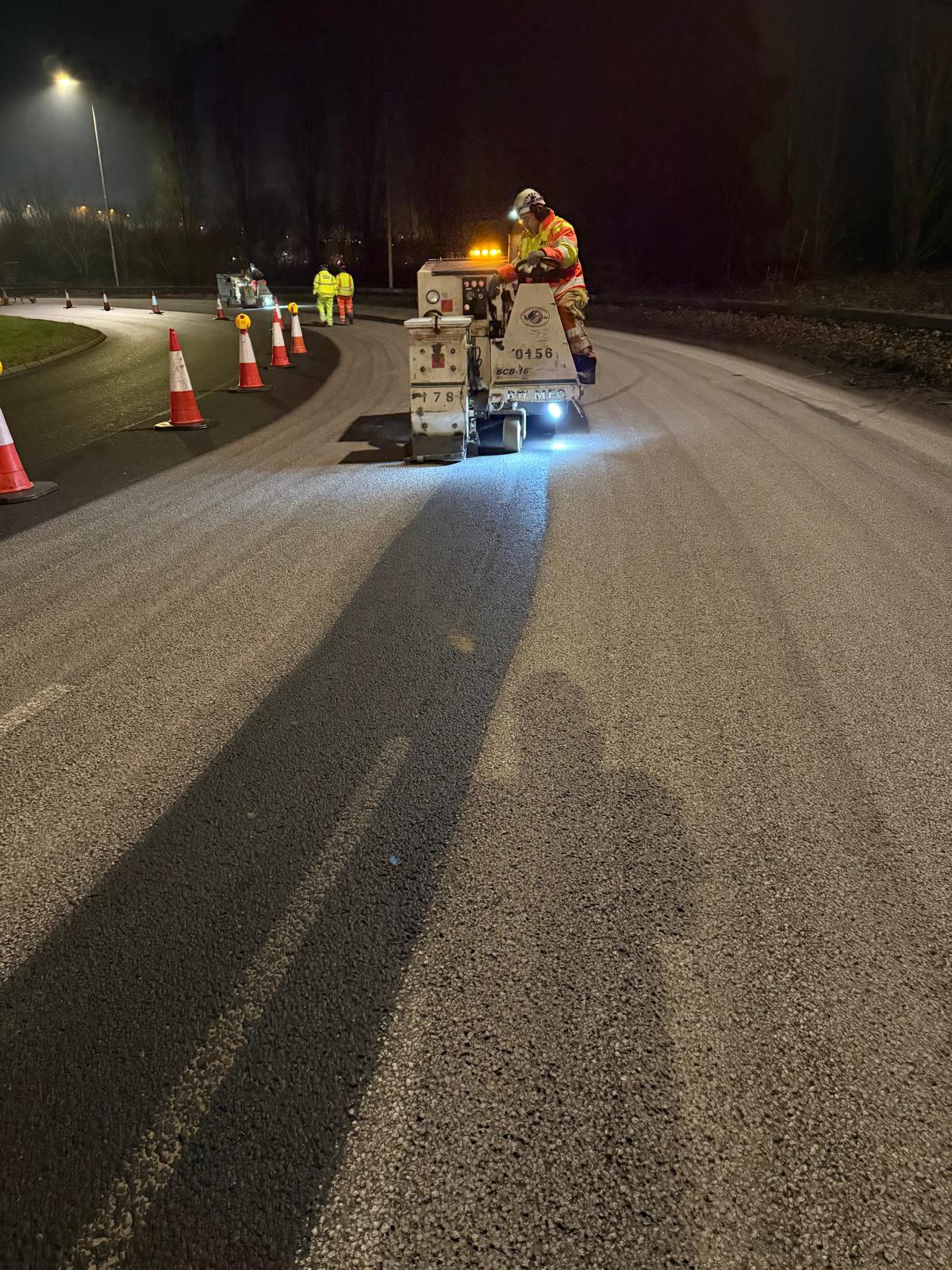
Image courtesy of WJ Group
National standards such as CS 228 (formerly HD28/15) recognise this heightened risk by assigning each location type an Investigatory Level (IL) of skid resistance. At roundabouts, tight radii and junction approaches, ILs typically fall around 0.45–0.50 SCRIM at 50 km/h. When friction falls below this threshold, the site triggers investigation and, where required, treatment. Research continues to show that these thresholds are meaningful: on roundabouts, sections below 0.50 SCRIM have been associated with around 20% higher collision risk and nearly double the proportion of wet-weather crashes compared with higher-friction sites. Maintaining skid resistance above IL is therefore a proven and measurable road-safety intervention.
Roundabouts and slip roads, by their nature, experience heavy braking, tight turns and high lateral loading. Over time, the combined action of traffic polishes the aggregate, binder film can mask the surface, and both microtexture and macrotexture reduce. Even if the road appears sound, its ability to provide grip – especially in the wet – is compromised. Stopping distances increase, vehicles become more prone to sliding under braking, and the safety margin for drivers shrinks.
These pinch points also have a disproportionate influence on network performance. A single skid-related collision at a busy roundabout can block multiple arms of a junction and create queues stretching far along the route. Traffic diverts onto unsuitable local roads, delays multiply, and emissions rise as vehicles sit in congestion. For operators working to maintain both safety and reliability, proactively managing skid resistance at these critical nodes is essential. The challenge is doing so without causing major disruption.
Captive shot blasting offers a powerful, efficient alternative. Instead of removing and replacing the pavement, the process restores skid resistance by mechanically retexturing the existing surface in situ. The technique involves propelling small steel shot at high speed onto the pavement, lightly abrading the polished surface, removing contaminants and exposing fresh, angular aggregate. This rejuvenates both microtexture and macrotexture, directly improving grip.
The equipment used is “captive,” meaning the shot and dislodged debris are vacuumed back into the machine immediately after impact. The steel shot is cleaned and recycled continuously, while waste fines are collected for safe disposal. The surface left behind is clean, dry and ready for traffic, with no loose grit, no sweeping required and no curing time. For night-time works, this allows the road to open again by the morning peak with no residual disruption.
Because captive shot blasting simply refreshes the top layer rather than replacing it, the method is significantly faster than resurfacing. A single unit can treat thousands of square metres per shift, allowing multiple arms of a roundabout or long slip road sections to be completed in a handful of night shifts. The safety benefit is immediate: restoring the surface texture lifts skid resistance back above the investigatory level, reducing wet-skid risk as soon as the road reopens.
The method is also highly cost-effective. Material costs are minimal because the existing surface is reused. Traffic management requirements are reduced due to short work windows, and user delays are far lower than those associated with multi-day resurfacing closures. Captive shot blasting enables authorities to address more high-risk sites within the same budget, and to intervene earlier—before low friction contributes to collision clusters.
Environmental performance is another advantage. With no asphalt manufacture, limited vehicle movements and reduced construction activity, the carbon footprint of shot blasting is dramatically lower than resurfacing. Less material, less plant and shorter programmes all contribute to significantly reduced CO₂ emissions. For local authorities working toward carbon-reduction targets, the technique supports safety, sustainability and efficiency simultaneously.
These benefits were demonstrated clearly on the A34 in Cheshire East. Routine SCRIM surveys identified several busy roundabouts with skid resistance below their IL. These junctions had become polished pinch points with a heightened wet-weather risk, and a conventional resurfacing scheme was estimated to require around four weeks of work with major closures and diversions.
Instead, WJ was commissioned to deliver a captive shot blasting programme. Following detailed assessment, approximately 13,000 m² of roundabout circulatory carriageway and approaches were successfully retextured over four overnight shifts. There were no daytime closures. Post-treatment grip testing confirmed skid resistance had been restored well above the investigatory level. The authority achieved significant cost savings and a substantial carbon reduction compared with resurfacing, while maintaining uninterrupted daytime operation of these key junctions.
Another advantage of working with WJ is the ability to maximise each closure. While on site with the shot blasting units, WJ can also refresh and amend road markings, replace road studs and address minor surface defects or patching. Bundling these essential works into the same overnight window eliminates the need for separate interventions and further reduces disruption. The result is a more resilient, more clearly marked and safer asset delivered in a single coordinated programme.
Maintaining skid resistance at roundabouts, slip roads and junction approaches is central to road-safety management and network performance. While resurfacing remains essential where structural renewal is required, it is not the only option available. Captive shot blasting provides a fast, efficient and sustainable method to restore friction at critical pinch points with minimal disruption and at a fraction of the cost and carbon footprint of resurfacing. When combined with marking enhancements and defect repairs, it allows road authorities to keep key junctions safe, open and performing at their best—while making maximum use of every closure.
Find out more: Captive Shot Blast Retexturing | Restore Micro and Macro Texture
WJ Group is the UK’s leading road marking and highway safety business, supporting high speed, local authority and off-highway markets by providing solutions that create safe, sustainable journeys for everyone. We specialise in Road Markings, Studs, Safety Surfacing, Retexturing, Surface Defect Repairs, TASCAR, CCTV, Stopped Vehicle Detection and other ITS solutions.


Join other savvy professionals just like you at CIHT. We are committed to fulfilling your professional development needs throughout your career

{{item.AuthorName}} {{item.AuthorName}} says on {{item.DateFormattedString}}: