
In association with Tarmac. The decarbonisation of construction is often discussed in terms of materials innovation, circularity, and energy transition. Yet one of the most immediate opportunities to reduce carbon emissions lies not only in what is produced, but in how it is transported. Logistics is the backbone of infrastructure delivery, and the choices made within fleet strategy can have a measurable impact on cost, productivity, and carbon intensity.
Join other savvy professionals just like you at CIHT. We are committed to fulfilling your professional development needs throughout your career
Tarmac moves millions of tonnes of aggregates and asphalt each year. Over 60% of its aggregate movements already take place on large articulated tippers, reflecting a long-standing commitment to operating at scale safely and efficiently. As expectations around sustainability increase and the driver shortage continues to deepen, the case for transitioning from traditional eight-wheel rigid vehicles to articulated tipping and ejector trailers has become increasingly compelling.
Ben Garner, Logistics Director at Tarmac, believes the conversation is not simply about bigger vehicles, but about designing a logistics model that is smarter, more resilient, and demonstrably lower in carbon. He argues that articulated tipping, walking floor and ejector trailers are central to delivering Tarmac’s 2030 CO2e ambitions, improving customer productivity and strengthening safety performance across the network. The following article explores why these vehicles represent not just an alternative to eight wheelers, but a necessary evolution in modern construction logistics.
Logistics represents a significant proportion of the embodied carbon associated with construction materials. While material innovations rightly attract attention, transport emissions can undermine those gains if fleet strategy is not aligned with carbon reduction objectives.
An articulated vehicle enables greater payload capacity than a rigid eight-wheeler. In practical terms, this translates to approximately 35% more material carried per journey. Fewer journeys are therefore required to deliver the same volume, resulting in around 35% fewer deliveries. On a per tonne basis, articulated tipping and ejector trailers deliver 32% to 35% lower CO2e emissions from transport compared to eight wheelers.
Beyond emissions, the productivity case is equally strong. Increased payload per vehicle means reduced vehicle changeovers at site, particularly in asphalt operations. With ejector trailers, the ability to discharge horizontally and at a controlled rate enhances paving gang productivity, cutting waiting times and reducing shift overruns. Fewer changeovers can mean up to 35% fewer vehicle movements into and out of site during active paving operations.
For customers, this translates into more consistent material supply, smoother operations, and improved scheme productivity. Plus, in a market facing acute driver shortages, moving more material with fewer drivers is not simply efficient. It is essential to maintaining service resilience.
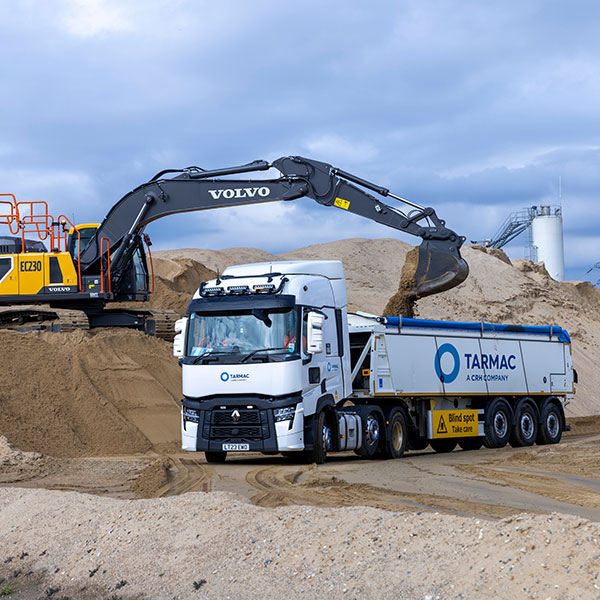
Tipping trailers have long been a mainstay of aggregate transport. With payloads typically between 28 and 29 tonnes and high manoeuvrability, they offer a cost effective and versatile solution for aggregates and, when insulated, for asphalt applications. In Ireland, for example, more than half of Roadstone asphalt is supplied on articulated tippers.
The primary operational consideration is safe tipping. This requires a suitable flat area with stable ground conditions. Tarmac’s contract haulage fleet is fitted with inclinometer systems that prevent tipping on slopes greater than three degrees, alongside high voltage overhead cable detectors and raised body alarms. The tractor unit must be aligned with the trailer during discharge to ensure stability.
These engineered controls, combined with robust driver training and compliance frameworks, mean that tipping trailers operate safely at scale across our network. They remain the most effective way of getting material to where it is needed while delivering significant carbon savings compared to rigid alternatives
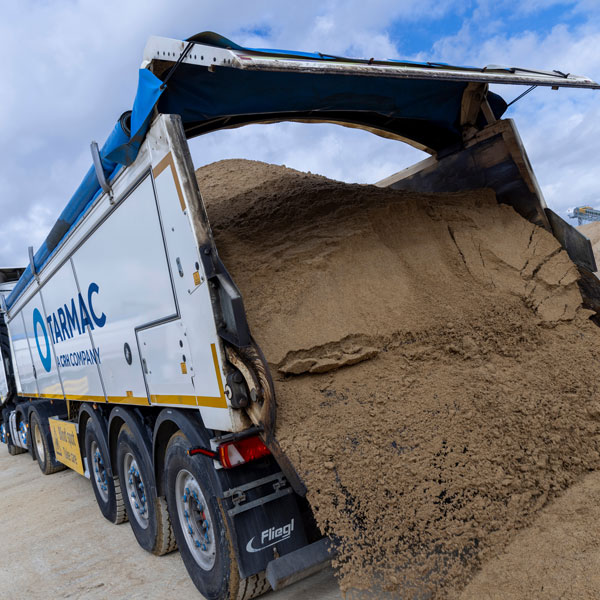
Not all articulated solutions rely on tipping. Walking floor and ejector trailers discharge material horizontally, eliminating the risk of tip over and removing concerns around overhead cable or bridge strikes. They can operate in a wider range of weather conditions and can discharge with the tractor unit at an angle to the trailer, offering flexibility in constrained sites.
Walking floor trailers typically carry 26.5 to 27 tonnes and are well suited to base and binder asphalt layers and aggregates. However, their floors cannot be insulated and ongoing wear can increase maintenance costs over time.
Ejector trailers represent a further evolution, particularly for asphalt. When a conventional tipper discharges asphalt, the colder top layer of the load can enter the paver in one section, creating the potential for temperature differentials and cold spots in the finished pavement. Ejector trailers push material out evenly, mixing the cooler and warmer portions as they enter the paver. The result is a more uniform temperature profile across the mat.
The performance implications are significant. More even temperature distribution supports improved compaction, enhanced warm mix workability and more durable pavements. Longer lasting roads that are less prone to weather damage reduce whole life carbon by minimising the need for early intervention and maintenance.
Ejector trailers are fully insulated across floor, walls, and tailgate, optimised for asphalt yet equally suitable for aggregates. With more than 17 years of proven operation across the EU, they combine reliability with lower ongoing maintenance costs compared to walking floor alternatives. Like other articulated solutions, they deliver around 32 per cent lower CO2e emissions from transport versus eight wheelers.
The move towards articulated tipping and ejector trailers is not driven by preference alone. Articulated configurations enable fleet flexibility, allowing tractor units and trailers to be deployed in response to demand. They support increased scheme productivity while embedding measurable carbon reduction into day-to-day operations.
Eight wheelers will continue to have a role in specific constrained environments. However, as a default model for high volume material movement, they represent a less efficient, higher carbon solution.
For Tarmac, logistics is an integral component of delivering sustainable infrastructure. By scaling the use of articulated tipping and ejector trailers, we are aligning operational excellence with environmental responsibility, ensuring that the roads and structures we help build are supported by a transport model fit for a low carbon future.


Join other savvy professionals just like you at CIHT. We are committed to fulfilling your professional development needs throughout your career
{{item.AuthorName}} {{item.AuthorName}} says on {{item.DateFormattedString}}: