
Motorways without a hard shoulder are no less safe than those with a continuous nearside lane into which drivers can pull into, Highways England’s chief executive has claimed.
Join other savvy professionals just like you at CIHT. We are committed to fulfilling your professional development needs throughout your career
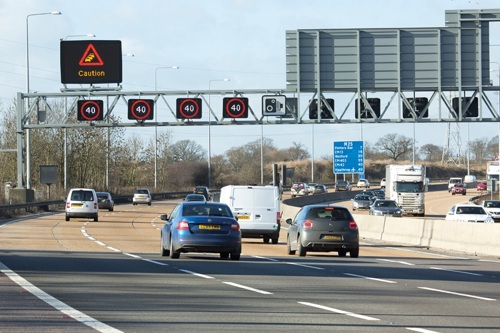
Speaking this morning at a Transport Select Committee evidence session, Jim O’Sullivan added that Smart Motorway technology means that all lane running sections of carriageway are “as safe or safer” than conventional motorway.
Jim was asked by Committee chair Lilian Greenwood if he would rather break down on a Smart or conventional motorway. “I would rather not break down in the first place,” he replied, but added that if he was to break down “I would prefer to be in an emergency refuge area than a hard shoulder”.
He added that vehicles stopped in the live lane of a Smart Motorway can be detected much more quickly than if vehicles are stopped on a traditional motorway. “You are safer on a Smart Motorway than you are on a traditional motorway.”
Jim and his colleague Mike Wilson were asked if they had statistics to hand that proved whether Smart Motorways with hard shoulders are safer than those without hard shoulders. The numbers were not to hand, to which Lilian Greenwood remarked: “It seems surprising that you are not able to tell us.”
Jim O’Sullivan added: “I am persuaded that the difference is so slight that I’ve not looked into it.”
Earlier in the session, Jim acknowledged that eight additional people have been killed so far this year on the entire motorway network compared to last year. “We are very disappointed with this year’s numbers and it has caused us to redouble our efforts, but we think the long term trend is good and are doing a number of things to improve safety.”
He was asked by the chair if there is any difference between fatalities per mile on conventional motorways than those on Smart Motorways. Jim replied: “If anything the Smart Motorway network is better than the conventional motorway network; our roads in this country are the safest in the world and at the top of the stack is motorways - you cannot split conventional motorway performance from Smart Motorways. The causes of accidents (on both) are very similar.”
Jim acknowledged that live lane breakdowns are more likely on Smart Motorways, but said that this could be because they tend to be the busier stretches of motorways.
He also pointed out that conventional hard shoulders are not as safe as an emergency refuge areas. “Live lane breakdowns happen on dual carriageways, conventional motorways and Smart Motorways. If you suffer a sudden engine failure on a conventional motorway, you are probably not going to make it to the hard shoulder.
“On Smart Motorways, we have a Midas system that detects traffic slowing down and we are starting to introduce stopped vehicle detection. It is probably more hazardous to break down on a conventional motorway than a Smart Motorway.”
Jim called on motorists who are aware of a problem with their vehicle not to press on if the next exit is several miles away, but to use the nearest emergency area on Smart Motorways.
He was asked about stopped vehicle detection technology, which is in place on 18% of all lane running stretches of motorway and what the timetable is to introduce it to all stretches. “We know that it works; we have three years of experience on the M25 and the first retrofit of the technology will be on the M3 this year and it is going to be incorporated on all schemes after 2020.”
(Photograph: Highways England)


Join other savvy professionals just like you at CIHT. We are committed to fulfilling your professional development needs throughout your career
{{item.AuthorName}} {{item.AuthorName}} says on {{item.DateFormattedString}}: