
Pedestrian behaviour has always been unpredictable – is that person really about to step into the road? – and is becoming more so, with many on foot focusing on their phones rather than the highway, writes TP Editor Mike Walter.
Join other savvy professionals just like you at CIHT. We are committed to fulfilling your professional development needs throughout your career
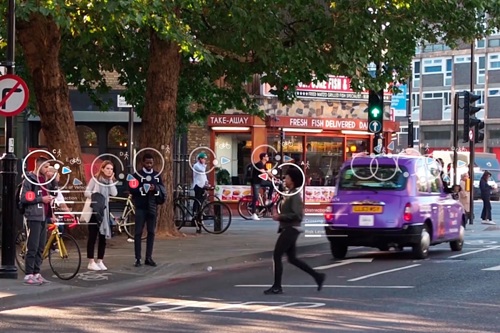
It can be hard enough for humans behind the wheel to guess the intentions of people up ahead, but how will driverless vehicles of the future be able to ensure that vulnerable road users stay safe?
Software company Humanising Autonomy will shortly be demonstrating a new ‘computer vision’ program designed to predict the likely actions of those on the street. The hope is that both autonomous (levels four and five) and human driven vehicles fitted with such technology will be able to make more informed decisions as to whether they can continue safely or need to slow down or stop.
Inside the firm’s central London headquarters a team of behavioural scientists, deep learning engineers and computer vision specialists is working to refine the artificial intelligence needed to predict the likely actions of pedestrians and cyclists too.
The company has entered discussions with vehicle manufacturers and equipment suppliers to integrate its software into autonomous driving systems, and will be demonstrating its latest features at the CES 2020 technology show in Las Vegas in January – which will also be attended by the Department for International Trade and Innovate UK.
It is also partnering with Arriva to trial the system on buses in London to help inform human drivers of the likely intentions of people up ahead.
“Development of safety systems associated with connected and autonomous vehicles have until now tended to focus on the occupants, rather than people outside,” says product manager Jennifer Sayer. “Our aim is to make sure that future vehicles are safe for everyone moving around.
“Many vehicle manufactures have started developing their own autonomous safety software, but they can’t solve every problem on their own,” she adds. “Our system should help improve safety of pedestrians, cyclists and other vulnerable road users.”
The system works by recognising the behaviour of people picked up by forward facing cameras; identifying whether they are aware of the vehicle approaching, if they are otherwise distracted, talking to another person, pushing a child’s buggy, or looking the other way. A series of scores are then provided for each individual including their ‘risk index’ and whether the person is in imminent danger.
In a demonstration of the system to TP Weekly News last Thursday, a video was shown of a car driving up the shared space environment of Exhibition Road in South Kensington. As a pedestrian wandered across the road they were immediately tracked with a coloured square, and their risk index was displayed in real time on a horizontal bar ranging from red (danger) to green (safe).
It certainly appeared to be more advanced and dynamic than many other ‘object detection’ technology proposed for driverless vehicles.
“As humans, we look out for the behaviours of those nearby and tend to know a few seconds beforehand if someone is about to cross the road or pass in front of a vehicle,” Jennifer explains. Autonomous vehicles, however, may need some help and is where such software could help to address this problem.
To view a video demonstrating the concept, click here.
(Image: Humanising Autonomy)


Join other savvy professionals just like you at CIHT. We are committed to fulfilling your professional development needs throughout your career
{{item.AuthorName}} {{item.AuthorName}} says on {{item.DateFormattedString}}: