
Connected and autonomous vehicles are widely considered to represent the next major step change in urban mobility, but what will come beyond that is less certain. Could cars that take to the skies ultimately be the solution to congestion in cities?
Join other savvy professionals just like you at CIHT. We are committed to fulfilling your professional development needs throughout your career
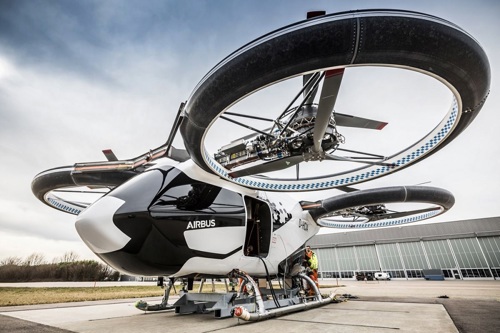
The question arises after French public transport authority RATP announced a partnership with aerospace company Airbus to study ‘integrating flying vehicles in urban transport’ last week, writes TP news editor Steve Dale.
Classic visions of the future – from 1927 film Metropolis to 1982’s Blade Runner – often depict flying cars. But Airbus chief executive Guillaume Faury says that “autonomous flights are no longer the reserve of science fiction”.
“We already have the technical blocks but we have to align them and integrate them into the user’s everyday life without compromising safety,” he went on. The RATP / Airbus collaboration intends to explore the feasibility of urban air mobility – in other words passenger drones – in the Île-de-France region.
The idea may sound far fetched to some. Yet already airborne drones are being tested that deliver parcels to customers’ doors, potentially removing a great number of vans from the road.
And RATP and Airbus are not the only ones considering transporting passengers over city skylines. Attendees to CIHT’s Young Professional’s conference last year may remember Uber’s head of cities Tom Younger discussing proposals for an ‘UberAir’ on demand aviation service, which could see a network of flying drones carrying people from rooftop to rooftop.
Just today, Atkins has announced a collaboration with electric aircraft company Vertical Aerospace to develop intercity air taxi services, which would be electric and capable of vertical take off and landing.
It has even been said that flying cars would be easier to introduce than autonomous vehicles. “Airspace is already regulated and people are quite happy to hand control of planes to machines,” noted Charlie Henderson of PA Consulting at a conference last year.
In addition he said they would significantly reduce the need to build and maintain highways, and would not present the problem of integration with non-autonomous vehicles, as expected on the roads.
But undoubtedly there are still significant challenges associated with the introduction of flying cars. Safety and perception of safety likely represents a major hurdle while managing airspace – already tricky enough over London with planes serving the capital’s airports – sounds a stressful task.
However if it can be made to work, who wouldn't be excited to see one of science fiction’s most enduring images of the future come to life?
(Image: Airbus)


Join other savvy professionals just like you at CIHT. We are committed to fulfilling your professional development needs throughout your career
{{item.AuthorName}} {{item.AuthorName}} says on {{item.DateFormattedString}}: