
The document states the current challenges and steps to be taken when developing the transport decarbonisation plan.
Join other savvy professionals just like you at CIHT. We are committed to fulfilling your professional development needs throughout your career
The forthcoming Transport Decarbonisation Plan is part of the Government's response to the Committee on Climate Change's recommendations in their 2019 progress report. The plan will set out in detail what is needed to do to deliver the emissions reduction needed across all modes of transport to achieve net zero emissions by 2050 and stay within the carbon budgets until then. The final plan is due to be published in the Autumn before the UK is hosting COP26 in Glasgow in November.
CIHT welcome the policy paper published by DfT. The paper gives us a first glimpse of how the government will seek to achieve transport decarbonisation. There are many challenges outlined in the paper and we look forward to working with DfT on potential solutions. While we welcome the ambition of the paper, on initial viewing we believe that the scope of the plan could be extended. For example, not all the co-benefits (e.g. improvements to public health and air quality) will be realised by technological solutions and switching to public transport and electric vehicles.
CIHT believe that any policy review must incorporate a national transport strategy that looks across the modes, includes the consideration of all modes, the role of infrastructure construction and spatial planning and their role in reducing emissions.
The policy paper identifies six strategic priorities:
CIHT, supported by the RTPI and TPS, has produced advice Better Planning, Better Transport, Better Places which addresses a key element in achieving sustainable transport through the integration of spatial planning and transport. The principles laid out in the advice will be crucial in making public transport and active travel the natural first choice for daily activities. CIHT continues to work with the government and the sector to ensure that the advice has a positive impact.
The scope of the plan is the mitigation of emissions as opposed to adaption of the effects climate change. The plan will consider the 'in use' greenhouse gas (GHG) emissions, meaning those that come from the use and operation of transport, thereby excluding the power generation and distribution for different transport modes. Excluded are also the emissions associated with the construction of transport infrastructure.
Co-benefits of the action taken are identified as the following:
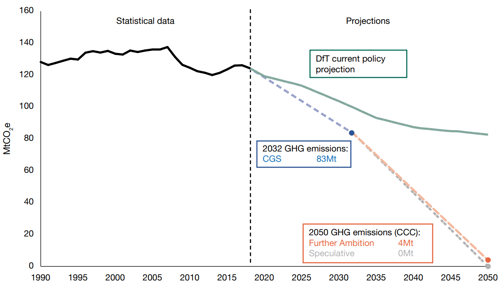
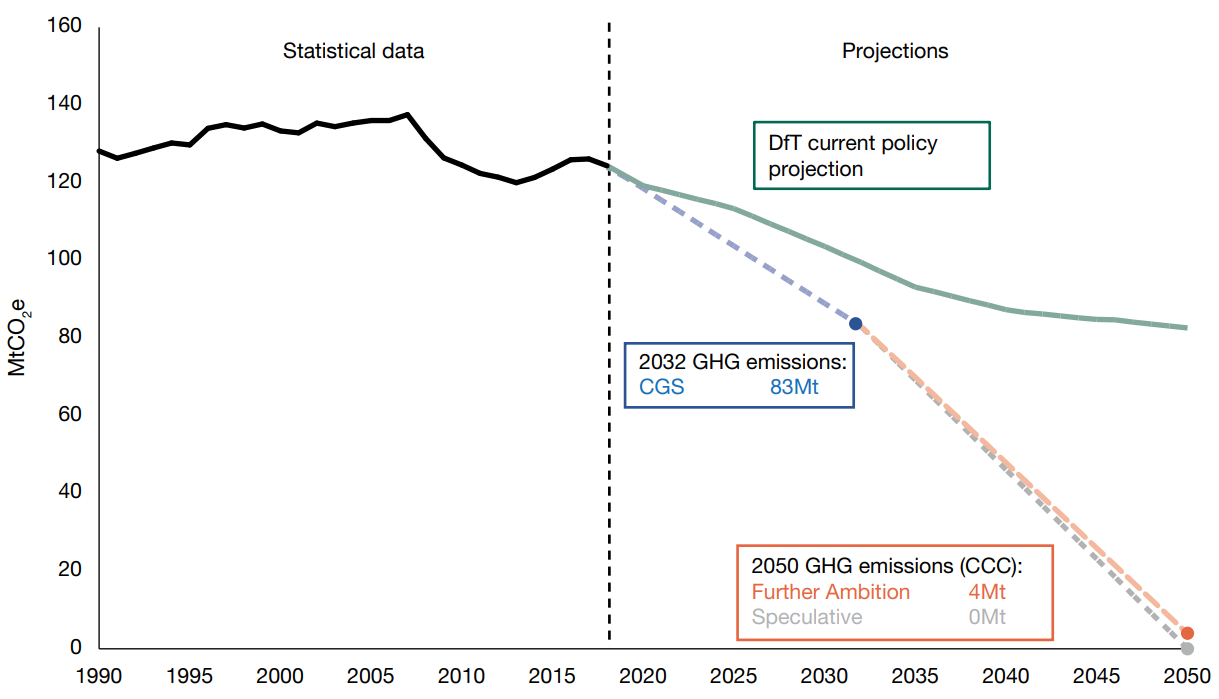
The below figure illustrates the path of transport emissions with current Department for Transport policy and funding and illustrates the scale of the challenge and need for new ambitious policies to achieve net zero. The Clean Growth Strategy (CGS) from 2017 included scenarios for meeting the fifth carbon budget (2028-32) which is shown as the purple line. This is however not current government policy.
 source: www.gov.uk
To develop the Transport Decarbonisation Plan DfT are now starting an extensive engagement process with the sector and the public. CIHT will be responding to the public feedback opportunity that will be announced in the Spring. If you would like to give your input to CIHT's response please e-mail technical@ciht.org.uk.
To see the full policy paper, please see here


Join other savvy professionals just like you at CIHT. We are committed to fulfilling your professional development needs throughout your career
{{item.AuthorName}} {{item.AuthorName}} says on {{item.DateFormattedString}}: