
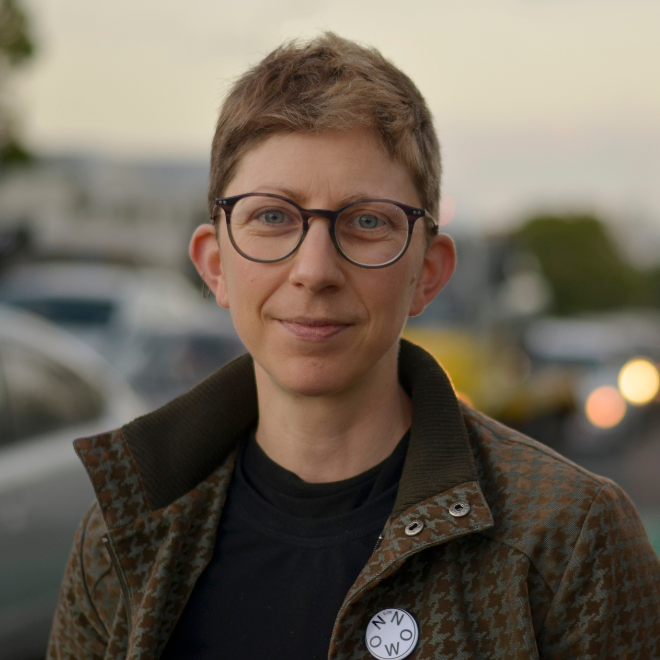
Dr Tamara Bozovic is Research Fellow in Transport Analysis, at the University of the West of England’s Centre for Transport & Society. A former transport engineer, she talks about her career to date, her recent research and the potential of artificial intelligence in solving transport challenges.
Join other savvy professionals just like you at CIHT. We are committed to fulfilling your professional development needs throughout your career
Words by Tamara Bozovic
My career started by studying civil engineering at the Swiss Federal Institute of Technology, specialising in transport. The climate crisis was a concern of mine and transport appeared to be a sector where we can make a change. That’s why I've always been interested in alternatives to driving.
I've been working for almost 20 years, in different kind of organisations, always looking at alternatives to the car. I worked in consultancy on projects around multimodal access; land use and transport integration; as a network planner for public transport in Switzerland; for a bike sharing start-up, or as independent, in Argentina, with a stint at the Institute for Transportation and Development Policy (ITDP).
I went to work for Waka Kotahi the New Zealand Transport Agency (NZTA) as a principal transport planner. That was, again, related to modal shift, helping local authorities develop their transport strategies and action plans.
Walking had long interested me as a sustainable mode, but I also became interested in the social justice aspect. Walking seems to be something that could and should be available to everyone, regardless of age, income, or impairments. Arriving in New Zealand, I was initially shocked to see to what extent building for traffic could make the place unsafe or unpleasant for walking, making other types of movement difficult, inconvenient or even impossible for some people.
I was starting to read about severance, which is difficulty in accessing the destinations you want to access (typically on foot). If you’re an older person trying to cross a busy road to get to a shop, but go somewhere else because of an uncrossable road, that's a form of severance: the road might exist for longer distance connections, but for create a barrier for local connections.
There wasn’t a great deal of research into the subject and it was also not something that was very well addressed in practice. Doing a PhD came across as an amazing opportunity to step back, read, and do research about the unintended consequences our transport systems can have on walking as a mode or exclusion of certain demographics, such as disabled people. The PhD came as an opportunity to do my own research and provide insights back to the practice.
If we want an evidence-based approach to allocate funding for walking, we need research to provide inputs and guidance, in terms of retrofitting the existing environment. When we design new developments and infrastructure, we tend to do it quite well, but what interested me was all the infrastructure that we inherited. How can we adapt infrastructure that was designed and built in another era, for one in which we want more walking?
Part of my research involved using artificial intelligence (AI), which was fascinating because I'm interested in the systems aspect of transport systems in urban systems, which involves considering a large number of parameters, without necessarily a well-defined theoretical framework - something that is difficult to do with conventional methods.
In this case, I tried predicting the frequency of walking based on over 40 variables expressing people’s preferences, attitudes to walking, perception of the walking environment, use of other mode, and demographics. Machine learning showed some predictive power and allowed identifying the relative importance of different variables in predicting walking, with some surprising results. My experience suggests that AI has the potential to help us explore comparable complex cases in future.
Tamara Bozovic was in conversation with Craig Thomas
>>> Access the webinar


Join other savvy professionals just like you at CIHT. We are committed to fulfilling your professional development needs throughout your career
{{item.AuthorName}} {{item.AuthorName}} says on {{item.DateFormattedString}}: