
Poor air quality impacts on the health of residents and workers in cities in particular. Urgent action is needed from local and national government to clean up the air we breathe says new report from Centre for Cities.
Join other savvy professionals just like you at CIHT. We are committed to fulfilling your professional development needs throughout your career
Centre for Cities, a think tank dedicated to improving the economies of the UK's largest cities and towns, has today (27/01/2020) published its Cities Outlook 2020 report which highlights the urgent need to reduce air pollution in the United Kingdom.
Air pollution kills thousands of people each year, and affects the health of many more. Although local data on the number of people whose health is affected by poor air quality is limited — what can be estimated are the deaths attributable to one pollutant, PM2.5, in cities across the UK. This one pollutant is estimated to have caused just over 14,400 deaths of those aged 25 or older in UK cities in 2017.
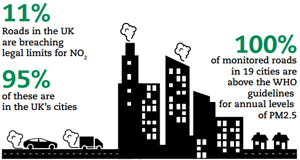
Source: https://www.centreforcities.org/wp-content/uploads/2020/01/Cities-Outlook-2020.pdf
Transport and the burning of wood and coal are the biggest contributors to air pollution. At a national level, road transport accounts for 34 per cent of all NO2 emissions, and this rises to 42 per cent in cities. There is a clear South / North divide to the problem. Across multiple indicators, cities in the South of England do worse than others.
The Centre for Cities report says that implementing some of the required policy measures is politically difficult due to the strength of the 'motoring and other lobbies', but by no means impossible as London has shown.
Recommendations from the report:
Further, it is recommended that the UK Government should:
The report also presents data from UK cities on a number of measures such as population, productivity, innovation, environment and more.
Source: www.centreforcities.org
For more on air quality see:
Blog post - How we came to understand the health impacts of air pollution
Technical article - Quintet of councils take aim to reduce pollution from vehicles
CIHT publications on streets and environment in the urban space


Join other savvy professionals just like you at CIHT. We are committed to fulfilling your professional development needs throughout your career
{{item.AuthorName}} {{item.AuthorName}} says on {{item.DateFormattedString}}: